


How can I improve the alarm sensitivity of a metal shell static wrist strap alarm?
Release Time : 2025-12-16
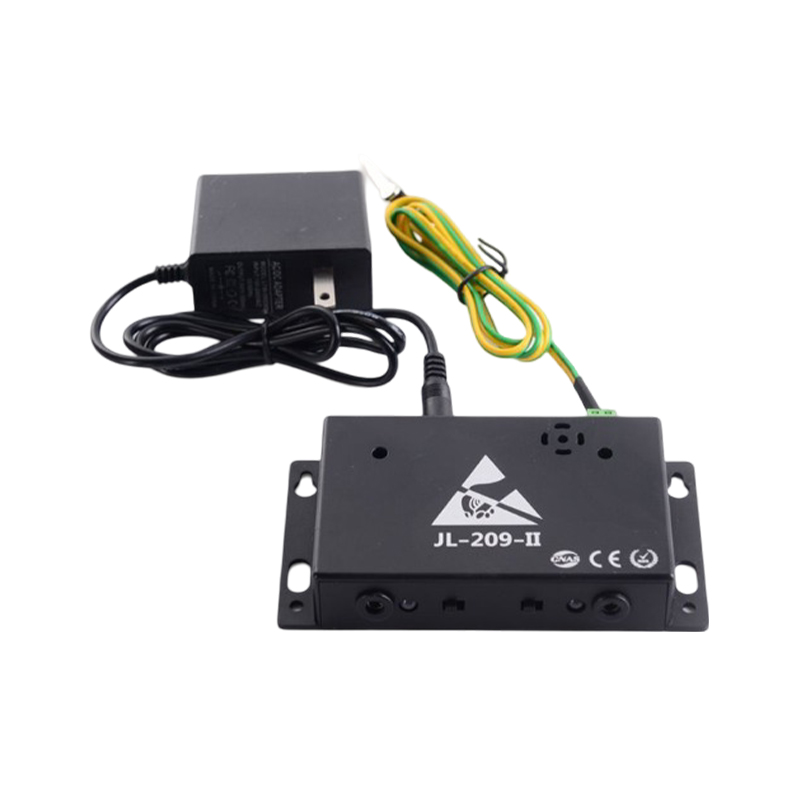
Metal shell static wrist strap alarms are critical protective devices in electrostatic-sensitive environments such as electronics manufacturing and semiconductor packaging. Their alarm sensitivity directly impacts the timeliness and reliability of electrostatic discharge. Improving sensitivity requires comprehensive improvements across multiple dimensions, including hardware design, circuit optimization, material selection, and environmental adaptability. The following is an analysis of specific technical approaches.
Hardware structure optimization is the core of improving sensitivity. The material and thickness of the metal shell directly affect electromagnetic shielding effectiveness and signal transmission efficiency. Using highly conductive metals (such as copper alloys) reduces signal attenuation. Simultaneously, precision machining ensures that the contact impedance between the shell and the internal circuitry is below 1Ω, preventing signal loss due to poor contact. Furthermore, the spring contacts at the connection between the shell and the wrist strap must use a highly elastic alloy to ensure stable contact pressure with the skin during wear, preventing sensitivity degradation caused by fluctuations in contact area.
Circuit design improvements are key to improving detection accuracy. Traditional metal shell static wrist strap alarms often use single-loop detection, which is susceptible to environmental interference, leading to false alarms or missed alarms. Improved solutions include introducing a dual-loop detection mechanism: one loop monitors the contact resistance between the wrist strap and the body, while the other monitors the integrity of the grounding loop. Through independent circuit design, dual verification can be achieved, immediately triggering an alarm when the resistance of any loop exceeds a set threshold (e.g., 1.068-2.0MΩ). Simultaneously, a fine-tuning potentiometer is integrated into the circuit, allowing users to fine-tune the detection threshold according to actual working conditions (e.g., different human body impedances), further improving sensitivity adaptability.
Sensor upgrades are a crucial means of improving response speed. Traditional metal shell static wrist strap alarms often use ordinary resistive sensors, whose response time is limited by material properties, typically in the millisecond range. Improved solutions can utilize thin-film pressure sensors or capacitive sensors: the former achieves rapid response by detecting minute pressure changes between the wrist strap and skin, while the latter utilizes the capacitance effect formed between the human body and the ground, reducing the response time to the microsecond range. Furthermore, sensor layout needs optimization, expanding the detection points from a single location to multiple key areas where the wrist strap contacts the skin, ensuring that any localized poor contact is promptly detected.
Signal processing algorithm optimization can significantly improve anti-interference capabilities. Traditional metal shell static wrist strap alarms often use a fixed threshold comparison method, which is susceptible to environmental electromagnetic interference or fluctuations in human body static electricity. An improved solution can incorporate an adaptive filtering algorithm to dynamically adjust the detection threshold by analyzing signal frequency and amplitude characteristics in real time. For example, the threshold can be automatically increased in high-frequency interference environments and decreased in low-frequency signals, thereby reducing false alarms while maintaining sensitivity. Furthermore, digital signal processing (DSP) technology can be used to achieve more complex signal analysis, such as extracting signal spectral features through Fourier transform to further distinguish between valid signals and noise.
The impact of material selection on sensitivity cannot be ignored. The conductive material of the inner layer of the wristband needs to possess both high conductivity and flexibility. Traditional carbon fiber materials are prone to increased resistance due to repeated bending. An improved solution could use silver fiber braided material, which has stable conductivity and is wear-resistant. The surface treatment process of the outer shell also needs optimization. Using gold or nickel plating can reduce oxide layer formation and ensure stable contact resistance during long-term use. In addition, the grounding wire should be made of low-impedance copper core wire, with a length controlled within 1 meter to reduce signal transmission loss.
Environmental adaptability adjustment is crucial to ensuring sensitivity stability. High-temperature environments can cause the metal shell to expand, potentially leading to loose internal circuit contacts; high-humidity environments may accelerate the oxidation of conductive materials, resulting in increased contact resistance. The improvements include adding a temperature compensation module inside the metal casing, using a thermistor to monitor temperature changes in real time and automatically adjust the detection threshold. Simultaneously, a humidity sensor is integrated into the circuitry; when humidity exceeds the threshold, a heating and dehumidification function is activated to ensure stable contact resistance. Furthermore, the casing's sealing design needs optimization, adopting an IP65-rated waterproof and dustproof structure to prevent dust or liquid intrusion from affecting sensitivity.
Regular calibration and maintenance are fundamental to ensuring long-term sensitivity stability. A detailed maintenance manual is also developed to guide users in regularly cleaning the contact surface between the wrist strap and the metal casing, checking the grounding connection, and recording calibration data to provide a basis for subsequent optimization. Through systematic calibration and maintenance, the metal shell static wrist strap alarm can maintain high sensitivity throughout its entire lifespan.