

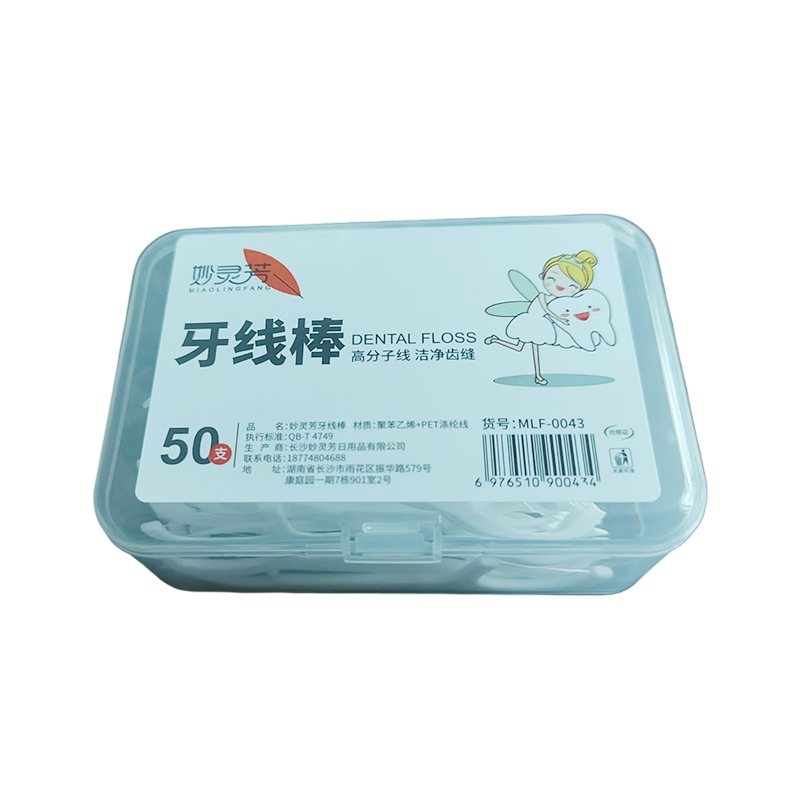




How do dental floss sticks avoid cross-contamination and bacterial growth?
Release Time : 2025-12-25
In modern oral care, cleaning between teeth is no longer an "optional" step, but a crucial step in maintaining gum health and preventing bad breath and cavities. However, when people choose to use dental floss, a crucial but often overlooked issue arises: could reusable traditional dental floss or shared tools become a breeding ground for bacteria? It is against this backdrop that disposable dental floss sticks, with their unique design and usage, effectively avoid the risks of cross-contamination and bacterial growth, becoming a more hygienic and reassuring daily care option.
First, the "one person, one use, disposable and replaceable" usage model is the core of preventing contamination. Each dental floss stick is individually molded and kept in a clean environment from production to packaging. Once opened, it is used only for a single oral cleaning and discarded immediately after use. This "disposable" mechanism completely cuts off the transmission path of bacteria between different areas of the teeth or between different users. In contrast, traditional roll-type dental floss requires repeated pulling during use, and the parts touched by fingers may become contaminated with skin microorganisms, posing a risk of secondary contamination when rewinding to the cleaning section. If family members share a roll of floss, the possibility of cross-infection is even greater. Dental floss sticks, however, fundamentally eliminate these risks.
Secondly, the fully sealed packaging ensures cleanliness before use. Commercially available dental floss sticks typically use sealed bags, blister packs, or individual plastic seals, effectively isolating them from dust, moisture, and microorganisms in the air. Even if carried in a bag for several days, as long as the seal remains unopened, its hygienic condition remains unchanged. Especially in situations where hand hygiene cannot be guaranteed, such as in the office, while traveling, or outdoors, this "ready to use, no contact" characteristic greatly enhances the safety margin, allowing users to perform oral care with confidence in any environment.
Furthermore, the structural design reduces indirect hand-mouth contact. Dental floss sticks use a plastic handle to hold the floss, allowing users to complete a full mouth cleaning simply by holding the end, without fingers needing to approach the mouth or touch the working section of the floss. This not only improves ease of use but also significantly reduces the risk of hand bacteria migrating to the oral mucosa or gum wounds through the tool. This is especially important for people with weakened immune systems (such as the elderly and post-operative patients) or users who pay attention to hygiene.
Furthermore, the material itself possesses a certain degree of antibacterial stability. The plastic handle and polymer floss material used in high-quality dental floss sticks are not prone to microbial growth under normal storage conditions. The surface of the floss is smooth and dense, non-absorbent, and does not trap dirt. Even with brief contact with saliva, it does not create a moist microenvironment conducive to bacterial growth. In addition, the usage time is extremely short (usually completed within a few minutes), and bacteria do not have time to colonize and multiply before the tool is discarded, further reducing the window for contamination.
On a deeper level, the disposable design also eliminates hygiene blind spots related to cleaning and storage. Traditional dental flossers, if intended for reuse, are often carelessly placed on damp bathroom countertops, exposed to a high-humidity, high-bacterial environment for extended periods, easily becoming breeding grounds for mold or E. coli. Dental floss sticks require no washing or storage; they are disposable after use, preventing secondary contamination from improper storage.
Of course, environmental concerns cannot be ignored. Brands now offer dental floss sticks made from biodegradable materials, ensuring hygiene while fulfilling ecological responsibilities, making "disposable" no longer synonymous with "unenvironmentally unfriendly."
Ultimately, the reason dental floss sticks effectively prevent cross-contamination and bacterial growth is not due to complex technology, but rather a simple and rigorous usage logic—single-use, independent, contactless, and disposable. It transforms oral care from a potentially risky activity into a proactive risk-blocking health practice. When a small dental floss stick gently glides between teeth after a meal, it removes not only food residue but also potential health hazards. In the unseen microscopic world, true cleanliness often begins with a decisive "use and throw away" approach.
First, the "one person, one use, disposable and replaceable" usage model is the core of preventing contamination. Each dental floss stick is individually molded and kept in a clean environment from production to packaging. Once opened, it is used only for a single oral cleaning and discarded immediately after use. This "disposable" mechanism completely cuts off the transmission path of bacteria between different areas of the teeth or between different users. In contrast, traditional roll-type dental floss requires repeated pulling during use, and the parts touched by fingers may become contaminated with skin microorganisms, posing a risk of secondary contamination when rewinding to the cleaning section. If family members share a roll of floss, the possibility of cross-infection is even greater. Dental floss sticks, however, fundamentally eliminate these risks.
Secondly, the fully sealed packaging ensures cleanliness before use. Commercially available dental floss sticks typically use sealed bags, blister packs, or individual plastic seals, effectively isolating them from dust, moisture, and microorganisms in the air. Even if carried in a bag for several days, as long as the seal remains unopened, its hygienic condition remains unchanged. Especially in situations where hand hygiene cannot be guaranteed, such as in the office, while traveling, or outdoors, this "ready to use, no contact" characteristic greatly enhances the safety margin, allowing users to perform oral care with confidence in any environment.
Furthermore, the structural design reduces indirect hand-mouth contact. Dental floss sticks use a plastic handle to hold the floss, allowing users to complete a full mouth cleaning simply by holding the end, without fingers needing to approach the mouth or touch the working section of the floss. This not only improves ease of use but also significantly reduces the risk of hand bacteria migrating to the oral mucosa or gum wounds through the tool. This is especially important for people with weakened immune systems (such as the elderly and post-operative patients) or users who pay attention to hygiene.
Furthermore, the material itself possesses a certain degree of antibacterial stability. The plastic handle and polymer floss material used in high-quality dental floss sticks are not prone to microbial growth under normal storage conditions. The surface of the floss is smooth and dense, non-absorbent, and does not trap dirt. Even with brief contact with saliva, it does not create a moist microenvironment conducive to bacterial growth. In addition, the usage time is extremely short (usually completed within a few minutes), and bacteria do not have time to colonize and multiply before the tool is discarded, further reducing the window for contamination.
On a deeper level, the disposable design also eliminates hygiene blind spots related to cleaning and storage. Traditional dental flossers, if intended for reuse, are often carelessly placed on damp bathroom countertops, exposed to a high-humidity, high-bacterial environment for extended periods, easily becoming breeding grounds for mold or E. coli. Dental floss sticks require no washing or storage; they are disposable after use, preventing secondary contamination from improper storage.
Of course, environmental concerns cannot be ignored. Brands now offer dental floss sticks made from biodegradable materials, ensuring hygiene while fulfilling ecological responsibilities, making "disposable" no longer synonymous with "unenvironmentally unfriendly."
Ultimately, the reason dental floss sticks effectively prevent cross-contamination and bacterial growth is not due to complex technology, but rather a simple and rigorous usage logic—single-use, independent, contactless, and disposable. It transforms oral care from a potentially risky activity into a proactive risk-blocking health practice. When a small dental floss stick gently glides between teeth after a meal, it removes not only food residue but also potential health hazards. In the unseen microscopic world, true cleanliness often begins with a decisive "use and throw away" approach.