


How does the internal circuitry of a metal shell static wrist strap alarm achieve anti-interference design?
Release Time : 2025-12-30
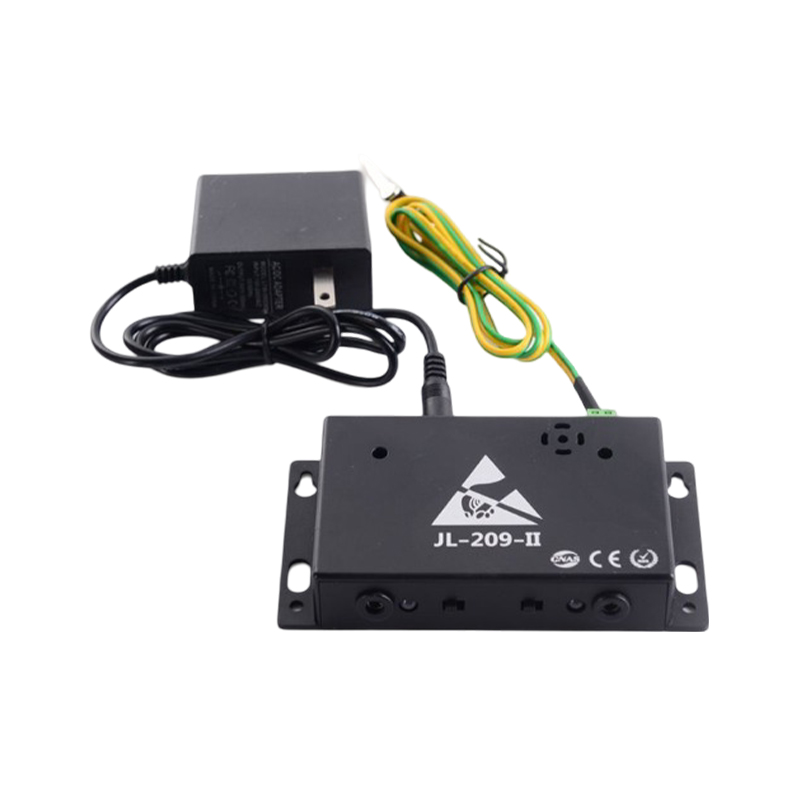
As a core device in the field of electrostatic discharge (ESD) protection, the anti-interference design of the internal circuitry of a metal shell static wrist strap alarm directly determines its alarm accuracy and reliability. The metal casing serves as both the basic carrier of electromagnetic shielding and a critical path for interference coupling, requiring coordinated structural and circuit design to achieve anti-interference goals. Its core design logic revolves around four dimensions: electromagnetic shielding, power purification, signal isolation, and grounding optimization, forming a multi-layered protection system.
The electromagnetic shielding effectiveness of the metal casing is the physical basis for anti-interference design. The casing is typically made of aluminum alloy or stainless steel, utilizing highly conductive materials to reflect and absorb electric field interference. The design must ensure seamless welding of the casing to prevent gaps from reducing shielding effectiveness. For high-frequency interference, the casing surface can be oxidized or coated with a conductive coating to increase surface resistance and dissipate high-frequency energy. Furthermore, the connection between the casing and the internal circuit board must achieve low-impedance contact through conductive springs or elastic contacts, ensuring that interference current can be directly discharged to ground through the casing, rather than coupled to sensitive circuits.
The anti-interference design of the power supply circuit is a crucial aspect ensuring the stable operation of the metal shell static wrist strap alarm. The power input typically employs a π-type filter network, composed of a common-mode inductor and X/Y capacitors, effectively suppressing differential-mode and common-mode interference from the power grid. For spike pulse interference, a varistor or TVS diode should be connected in parallel to clamp the voltage to a safe range through the rapid response of nonlinear components. The power conversion section should use a low-noise LDO or switching power supply chip, and ferrite beads and ceramic capacitors should be added at the output to further filter high-frequency noise. Furthermore, power traces should follow the "short, thick, and straight" principle to reduce parasitic inductance and resistance, avoiding false alarms caused by power fluctuations.
The anti-interference design of the signal transmission channel needs to address both isolation and filtering. Metal shell static wrist strap alarms typically contain detection signal lines, control signal lines, and communication lines, which are prone to interference through capacitive coupling or electromagnetic induction. For analog detection signals, a ferrite bead or ferrite inductor should be connected in series at the input to form a low-pass filter characteristic, suppressing high-frequency noise. Simultaneously, the signal lines should use a twisted-pair structure to cancel common-mode interference through twisting. Digital control signals require electrical isolation via optocouplers or digital isolators to cut off ground loop interference. For communication interfaces such as RS485 or I2C buses, terminating resistors should be added to the bus, and shielded twisted-pair cable should be used for transmission to reduce reflection and radiation interference.
Optimized grounding system design is a core aspect of anti-interference design. The metal casing should be connected to the system ground via a single-point grounding method to avoid ground loops caused by multiple grounding points. The internal circuit board should use a complete ground plane and achieve multiple low-impedance connections to the casing via vias. For sensitive circuits, such as detection amplification circuits, independent ground areas should be defined and isolated from the main ground using 0-ohm resistors or ferrite beads to reduce the coupling of digital circuit noise. Furthermore, grounding traces should avoid forming loops, and all grounding pins should be connected to the ground plane as close as possible to reduce parasitic inductance.
The anti-interference design of a metal shell static wrist strap alarm also needs to consider environmental adaptability. In industrial scenarios, the equipment may face harsh conditions such as high temperature, humidity, or vibration, requiring methods such as conformal coating and reinforced installation to improve reliability. For high-static-area environments, the casing needs to incorporate additional static discharge paths, such as using conductive rubber pads to directly conduct static electricity to ground, preventing static buildup and false triggering. Furthermore, the circuit design must incorporate sufficient redundancy, such as increasing filter capacitor capacity and improving component withstand voltage, to cope with extreme interference scenarios.
The anti-interference design of a metal shell static wrist strap alarm is a systematic engineering project, requiring comprehensive optimization from material selection, circuit topology, layout and wiring to grounding strategies. Through the synergistic effect of electromagnetic shielding, power purification, signal isolation, and grounding optimization, the stability and reliability of the metal shell static wrist strap alarm in complex electromagnetic environments can be significantly improved, providing a solid guarantee for anti-static monitoring.